So this is my first blog post of (hopefully) many! Since this blog was initially created for my Classical Era music history class, the first series of blog posts will center around topics chosen by my professor. I’ll try to format everything in a way so it’s fluid when read vs. just question/answer. The book I will be referencing all my sources from will be “The Classical Style: Haydn, Mozart, Beethoven” by Charles Rosen. if I use any other sources I’ll of course mention them as needed. Enjoy!
Mozart, Haydn, and Beethoven are seen as very influential figures of the classical era (Beethoven would bleed into the romantic era). E.T.A Hoffman was a music critic of this era who held a high respect for these three figures of music. He would go on to consider them the first “romantic” composers due to their personal developments of musical art at that time. Hoffman also goes to mention that many at the time many composers tried to give the impression of the real thing (this “real thing” being the quality of Mozart, Haydn, and Beethoven’s quality of music).
According to Rosen, the classical style developed due to the musical consumer’s desire for a mode of understanding. The Baroque era ended in the 1750’s, but at the time it wasn’t seen as a concrete “this is the end of Baroque”. Mozart would have still been able to have composed a quality Baroque piece, but he instead took the coherent/musical language of Baroque and brought it to his own form of expression. This was the desire of the audience of that time from the likes of Mozart, Haydn, and Beethoven.
The topic of art/music history can be described as problematic. This is due to the fact that only what is seen as great works, not just the the typical works, lays a claim to our attention/study. for a example of this think of a popular musical artists. While they may have a high volume of music released, only their “big radio hits” are remembered by the casual listener. A misinterpretation this brings is that whatever an artists’ greatest work is is the norm of their personal style, not simply the exception. This disregard for the average works of any specific era contradicts the possibility of a precise agreement of what is art/music history.
Now days classical era music is often seen as background music for some funny videos or for your average college student to study to. With the comings of Haydn, Mozart and Beethoven also came a slew of minor composers who are still only known as anonymous to this day. many of these minor composers held habits that simply were being phased out and no longer made sense in the new concept of music. It is only Haydn, Mozart and Beethoven’s works that all the elements of music-melodic, rhythmic, and harmonic- work coherently together to stand the test of time. They all had their own way of standing out among the vast amount of composers.
During this time of history, the definition of tonality was not quite specified yet. Rosen goes to describe it as unbalanced. He seemed to be conflicted as to whether it is based upon the circle of fifths with triads and whatnot, or based upon the major and minor scales with modal centers. Another system he mentions is Equal Temperment. This forces an equal distance between the 12 notes in a chormatic scale and distorts the relation to their natural overtones
The tonic-dominant relationship was seen as very important in the 18th century. Moving from a note to the dominant (or by 5ths e.g C-G-D, etc). This works well because it builds upon the overtones of the previous note. The dominant movement outweighsmoving in subdominant direction (by 4ths e.g. C-F-Bb, etc) which uses the previous not not into a central note of the triad, but an overtone. This imbalanced leads to the basics of tension and release within music for centuries
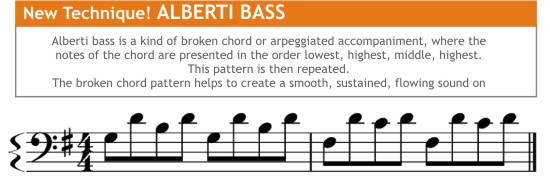
The Alberti Bass was significant in the 18th century due to its destruction of the linear aspect of music from being purely horizontal. This change includes a more vertical aspect of music that was typical in Baroque accompaniment figures. Alberti bass breaks down the voices by integrating them into a line with the chords being within constant movement.
 William Joiner's Music World
Nice work William?
LikeLike